Thank you for Subscribing to Environmental Business Review Weekly Brief


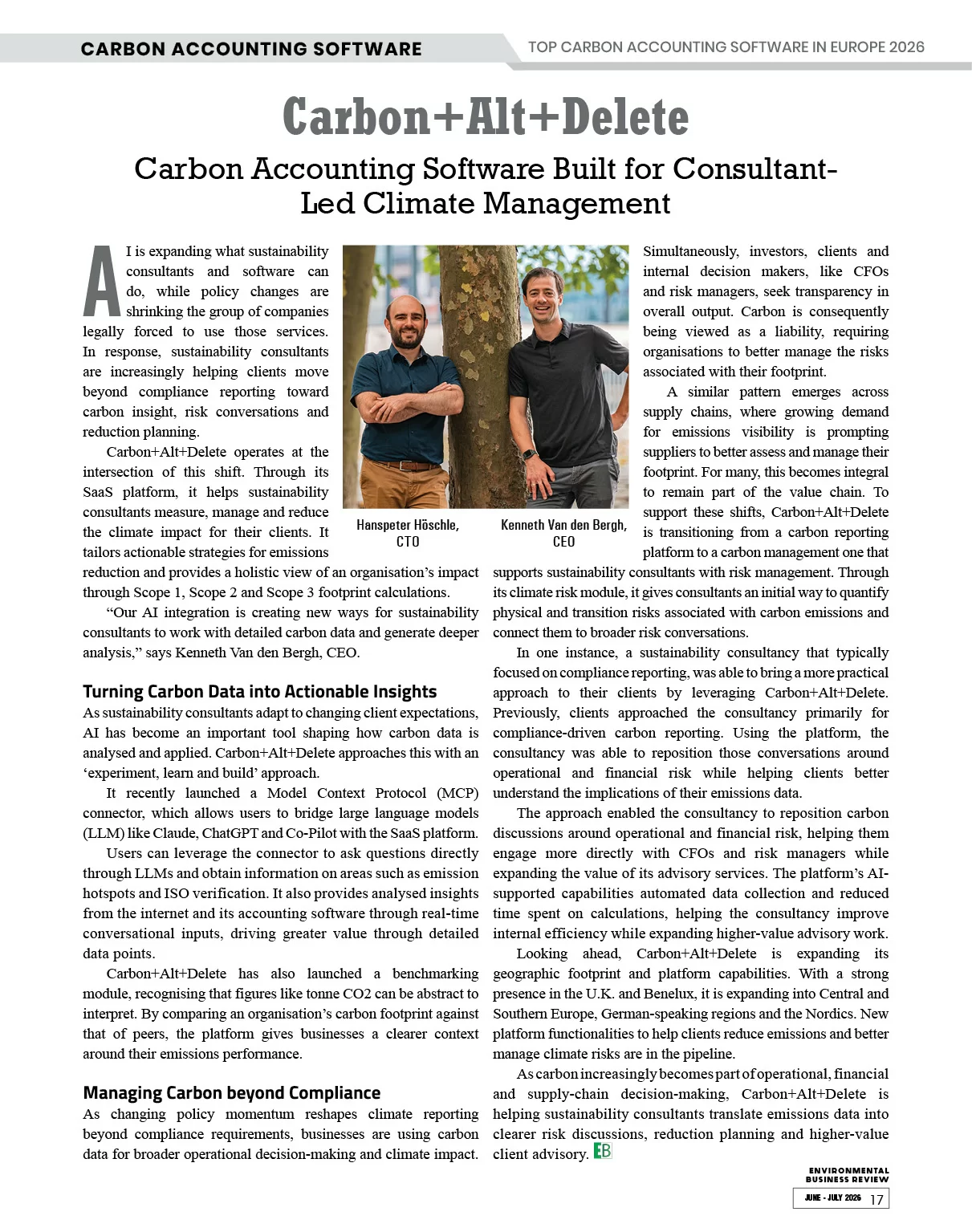
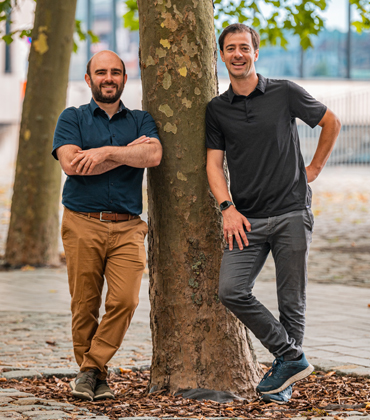 Hanspeter Hoschle, CTO and Kenneth Van den Bergh, CEO
AI is expanding what sustainability consultants and software can do, while policy changes are shrinking the group of companies legally forced to use those services. In response, sustainability consultants are increasingly helping clients move beyond compliance reporting toward carbon insight, risk conversations and reduction planning.
Carbon+Alt+Delete operates at the intersection of this shift. Through its SaaS platform, it helps sustainability consultants measure, manage and reduce the climate impact for their clients. It tailors actionable strategies for emissions reduction and provides a holistic view of an organisation’s impact through Scope 1, Scope 2 and Scope 3 footprint calculations.
“Our AI integration is creating new ways for sustainability consultants to work with detailed carbon data and generate deeper analysis,” says Kenneth Van den Bergh, CEO.
Turning Carbon Data into Actionable Insights
As sustainability consultants adapt to changing client expectations, AI has become an important tool shaping how carbon data is analysed and applied. Carbon+Alt+Delete approaches this with an ‘experiment, learn and build’ approach.
It recently launched a Model Context Protocol (MCP) connector, which allows users to bridge large language models (LLM) like Claude, ChatGPT and Co-Pilot with the SaaS platform.
Users can leverage the connector to ask questions directly through LLMs and obtain information on areas such as emission hotspots and ISO verification. It also provides analysed insights from the internet and its accounting software through real-time conversational inputs, driving greater value through detailed data points.
Carbon+Alt+Delete has also launched a benchmarking module, recognising that figures like tonne CO2 can be abstract to interpret. By comparing an organisation’s carbon footprint against that of peers, the platform gives businesses a clearer context around their emissions performance.
Managing Carbon beyond Compliance
As changing policy momentum reshapes climate reporting beyond compliance requirements, businesses are using carbon data for broader operational decision-making and climate impact. Simultaneously, investors, clients and internal decision makers, like CFOs and risk managers, seek transparency in overall output. Carbon is consequently being viewed as a liability, requiring organisations to better manage the risks associated with their footprint.
-
Our AI integration is creating new ways for sustainability consultants to work with detailed carbon data and generate deeper analysis.
A similar pattern emerges across supply chains, where growing demand for emissions visibility is prompting suppliers to better assess and manage their footprint. For many, this becomes integral to remain part of the value chain. To support these shifts, Carbon+Alt+Delete is transitioning from a carbon reporting platform to a carbon management one that supports sustainability consultants with risk management. Through its climate risk module, it gives consultants an initial way to quantify physical and transition risks associated with carbon emissions and connect them to broader risk conversations.
In one instance, a sustainability consultancy that typically focused on compliance reporting, was able to bring a more practical approach to their clients by leveraging Carbon+Alt+Delete. Previously, clients approached the consultancy primarily for compliance-driven carbon reporting. Using the platform, the consultancy was able to reposition those conversations around operational and financial risk while helping clients better understand the implications of their emissions data.
The approach enabled the consultancy to reposition carbon discussions around operational and financial risk, helping them engage more directly with CFOs and risk managers while expanding the value of its advisory services. The platform’s AI-supported capabilities automated data collection and reduced time spent on calculations, helping the consultancy improve internal efficiency while expanding higher-value advisory work.
Looking ahead, Carbon+Alt+Delete is expanding its geographic footprint and platform capabilities. With a strong presence in the U.K. and Benelux, it is expanding into Central and Southern Europe, German-speaking regions and the Nordics. New platform functionalities to help clients reduce emissions and better manage climate risks are in the pipeline.
As carbon increasingly becomes part of operational, financial and supply-chain decision-making, Carbon+Alt+Delete is helping sustainability consultants translate emissions data into clearer risk discussions, reduction planning and higher-value client advisory.
From Reporting Obligation to Risk Intelligence in Carbon Accounting Software
Carbon accounting software in Europe has entered a phase where compliance alone no longer justifies investment. Regulatory momentum has softened in parts of the region, yet scrutiny from investors, supply chain partners and financial stakeholders has intensified. Executives are no longer measuring emissions simply to satisfy reporting mandates; they are doing so to understand exposure, anticipate financial implications and inform decision-making. This shift places new expectations on software platforms, which must translate emissions data into insight that can be used beyond sustainability teams.
Traditional tools have struggled to keep pace with this evolution. Many remain anchored in periodic reporting cycles, producing outputs that satisfy disclosure frameworks but offer limited guidance on what actions to take next. The gap becomes more visible when finance leaders and risk managers demand clarity on how carbon exposure affects enterprise value. Emissions figures in isolation carry little meaning unless they are contextualised, compared and connected to business risk. Platforms that fail to bridge this gap risk becoming redundant as organisations prioritise systems that support continuous monitoring and decision support.
A second pressure point lies in the complexity of data collection and interpretation. Carbon accounting involves fragmented inputs across operations, supply chains and third-party systems, often requiring significant manual effort to consolidate. Software that reduces this burden while maintaining accuracy is increasingly valued, particularly as organisations seek to control costs without sacrificing analytical depth. Efficiency gains are not only about automation but also about enabling faster interpretation, allowing teams to move from measurement to action without delay.
Advances in artificial intelligence are beginning to reshape expectations in this regard. Executives are exploring ways to interact with data more intuitively, moving away from static dashboards toward conversational interfaces that can surface insights on demand. This changes the role of carbon accounting software from a system of record to a system of inquiry, where users can interrogate emissions data, validate assumptions and identify hotspots in real time. The ability to integrate such capabilities without compromising data integrity or governance is becoming a distinguishing factor.
“By working closely with sustainability consultants, it combines software efficiency with domain expertise, allowing organisations to reduce data-processing effort while extracting greater value from their carbon insights.”
Against this backdrop, platforms that combine accurate reporting, analytical depth and usability are emerging as the benchmark. The most effective solutions do not treat emissions data as an endpoint but as a starting point for risk assessment and strategic planning. They provide mechanisms to quantify exposure, compare performance against peers and guide prioritisation of reduction efforts. In doing so, they align sustainability reporting with financial and operational decision-making, making the output relevant to a broader set of stakeholders.
Carbon+Alt+Delete reflects this direction by positioning its software as an extension of advisory expertise rather than a standalone tool. It integrates with external large language models through a connector that allows users to query emissions data conversationally, enabling faster identification of inconsistencies, hotspots and compliance gaps.
Its platform has also expanded beyond reporting to include modules that quantify climate-related risks and benchmark performance against peers, helping organisations interpret emissions in terms that resonate with finance and risk functions. By working closely with sustainability consultants, it combines software efficiency with domain expertise, allowing organisations to reduce data-processing effort while extracting greater value from their carbon insights.
...Read more
Insights
The Measurable Cost of Fossil Energy Dependence
Kenneth Van den Bergh, Co-founder and CEO Recent geopolitical developments make it clear that fossil fuel dependence is not an abstract climate issue but a tangible economic risk.

Carbon Accounting Software in Europe Info
Q1
What Should Organizations Expect from Carbon Accounting Tools?
Good carbon accounting tools should do more than add up emissions. They should show where the data came from, how calculations were made and which reporting standards were used. Carbon Accounting Software in Europe is often expected to support Scope 1, 2 and 3 reporting, audit trails, emission factor selection and clear documentation. Without that structure, teams can end up rebuilding inventories every time a regulation changes or an assurance review begins. The best systems make updates simple while keeping the underlying data transparent.
Q2
How Does Carbon+Alt+Delete Support Sustainability Consultants?
Sustainability consultants often spend too much time cleaning data, matching invoices to emission factors and updating client inventories. Carbon+Alt+Delete is built around that reality. Its cloud-based platform uses AI to help screen invoices and map emission factors, reducing repetitive work and freeing consultants to focus on climate strategy. Instead of stopping at measurement, they can spend more time helping clients understand and reduce their emissions.
Q3
Why Does Carbon Accounting Software in Europe Need Strong Standards Alignment?
European reporting requirements demand clear and consistent methodology. Carbon Accounting Software in Europe should help organizations align calculations with frameworks such as the GHG Protocol, ISO 14064-1 and European sustainability reporting requirements. A weak data trail can slow assurance reviews and create doubts about reported results. Strong standards alignment makes reporting more credible and helps different teams work from the same set of rules.
Q4
What Data Features Matter Most in Emissions Reporting?
Accurate reporting depends on reliable activity data and the right emission factors. Carbon Accounting Software in Europe should make it easy to import data, document assumptions, select factors and update calculations without losing past decisions. Broad emission factor libraries are especially useful for consultants working across different industries. A good system should allow anyone reviewing the footprint to follow the calculation from source data to final result without digging through spreadsheets and emails.
Q5
How Should Buyers Evaluate Carbon Accounting Platforms?
A polished demo only goes so far. Buyers should test Carbon Accounting Software in Europe using real invoices, supplier records, travel data or energy reports to see how the platform handles missing information, factor selection and reporting changes. It is also worth reviewing audit trails, user permissions and export options when several people work on the same inventory. The right platform cuts duplicate work while keeping reporting accurate and defensible.
Q6
What Makes Carbon+Alt+Delete Relevant to This Category?
Carbon+Alt+Delete reflects a growing shift in Carbon Accounting Software in Europe toward tools built for the way consultants actually work. The platform includes third-party validation, access to major emission factor databases such as IEA, Ecoinvent and Exiobase, and tools for exploring greenhouse gas inventories through an MCP connector. Those features help consultants produce reliable footprints while uncovering clearer opportunities for carbon reduction.
