Thank you for Subscribing to Environmental Business Review Weekly Brief
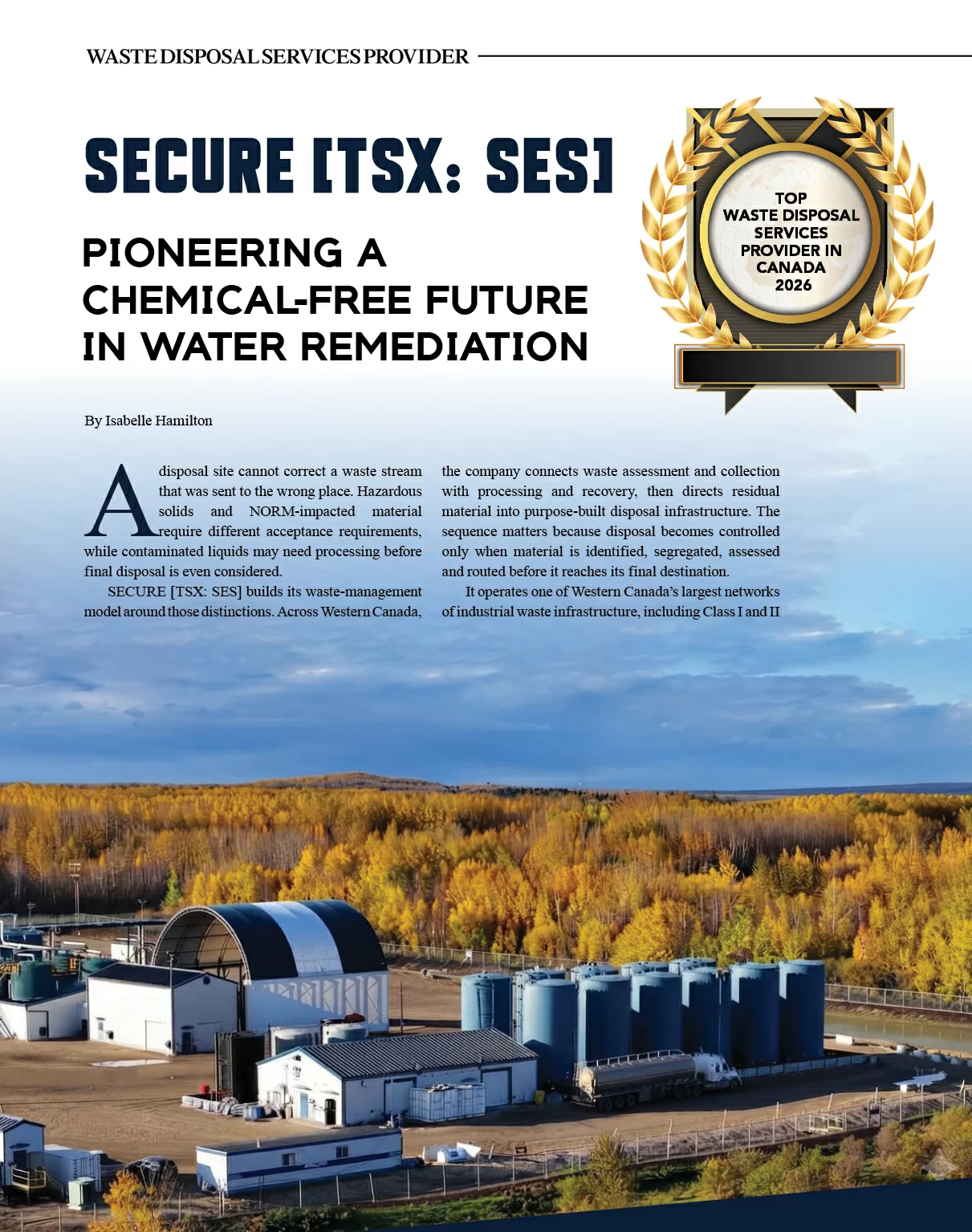
SECURE [TSX: SES] has been recognized by Environmental Business Review Magazine as the exclusive recipient of “Top Waste Disposal Services Provider in Canada 2026,” based on our proprietary methodology, reflecting its position in the industry, and is also named among “Top Waste Management Company in Canada,” reflecting its broader leadership. This profile has been developed by the Environmental Business Review research and editorial team based on insights from an interview with Allen Gransch, President and CEO.

SECURE [TSX: SES]
From Waste Identification to Final Containment
![SECURE [TSX: SES]](/company_logos/Untitled-6-ykwm.jpg "SECURE [TSX: SES]")
A disposal site cannot correct a waste stream that was sent to the wrong place. Hazardous solids and NORM-impacted material require different acceptance requirements, while contaminated liquids may need processing before final disposal is even considered.
SECURE [TSX: SES] builds its waste-management model around those distinctions. Across Western Canada, the company connects waste assessment and collection with processing and recovery, then directs residual material into purpose-built disposal infrastructure. The sequence matters because disposal becomes controlled only when material is identified, segregated, assessed and routed before it reaches its final destination.
It operates one of Western Canada’s largest networks of industrial waste infrastructure, including Class I and II landfills. Its disposal portfolio also extends underground through salt caverns, while deep disposal wells provide another permitted route for certain liquid streams. Rather than treating disposal as one endpoint, SECURE matches the waste to the infrastructure designed to contain it.
Know the Waste Before Disposal
The decision starts with characterization. Before material is shipped to a SECURE landfill, generators are required to identify the waste stream and obtain approval against the receiving facility’s acceptance criteria. Province-specific protocols set out the analytical information needed for different wastes, allowing the disposal route to be determined before the truck moves.
SECURE’s disposal model starts with knowing the waste, then matching the residual material to infrastructure designed to contain it safely over the long term.
Collection is built around the same discipline. SECURE operates more than 10,000 waste containers across Canada, including designs for filters, NORM material, self-heating waste and sludge. Shipping documents and waste approvals keep the material identified through the transfer process until it reaches the receiving facility.
That front-end control reduces the chance of discovering a mismatch at the landfill gate. Class I hazardous waste and Class II industrial waste are not interchangeable, and specialized streams can require additional procedures before acceptance. Disposal integrity begins at the generator’s site, where the waste is first defined.
Recover What Still Has Value
Final disposal is not always the first useful destination for industrial waste. SECURE’s processing network handles material that may still contain recoverable value before the remaining waste moves toward permanent containment.
Processing can separate recoverable oil from contaminated material so that the oil can return to market. Water can move through an appropriate treatment route, while residual solids proceed to disposal when further recovery is no longer practical. SECURE reports recovering about 1.2 million barrels of oil from waste, giving its disposal model a clear recovery step before the remaining material reaches a final endpoint. The distinction keeps the award focus intact. SECURE is still a disposal provider, but the disposal decision is more controlled because recoverable material can be removed first. Waste that finally reaches a landfill or another permitted endpoint has already passed through a process that determines whether useful fractions can remain in circulation.
Match Waste to Disposal Infrastructure
SECURE operates the largest network of Class I and II landfills in Western Canada. Those facilities give industrial customers access to disposal capacity for hazardous and non-hazardous waste under different acceptance requirements.
Pembina is a particularly important part of that network. It is one of two Class I hazardous-waste landfills in Western Canada and can accept NORM-impacted material under specialized procedures. The site demonstrates why disposal capability depends on infrastructure design rather than acreage alone. Containment begins with engineered barrier systems, and leachate collection manages liquids within the disposal cell. Groundwater and surface-water controls add another layer of protection around the site.
-
Recovery changes the disposal decision by removing useful material first, leaving the remaining waste to move into the permitted route built for its characteristics.
Not every material belongs in a landfill. SECURE also uses underground salt caverns for certain oilfield and industrial wastes, where the surrounding salt formation provides the containment barrier. Industrial wastewater may move to deep disposal wells where geology and regulation permit that route. The advantage is choice with limits. Each route exists for a defined type of waste, so the operating question is not simply where capacity is available. It is, which permitted infrastructure matches the material that needs to be managed.
Specialist Waste Needs Specialist Handling
NORM-impacted waste shows how much additional control some disposal streams require. SECURE operates four licensed NORM facilities and supports the work with monitoring, sampling, specialized transport and decontamination procedures.
Radiation-protection plans and material-specific acceptance requirements govern how affected waste is handled. At Pembina, specialized NORM personnel support testing and characterization before disposal, giving the facility the expertise needed to manage material that cannot move through an ordinary industrial-waste process.
Specialized containers are part of that control as well. NORM material can be kept segregated during collection and transport, so its status remains clear before it arrives at the receiving site. The disposal service includes more than the final placement of waste. It includes the controls needed to get difficult material there without losing track of what it is.
The same principle applies when a waste stream falls outside routine handling. The more specialized the material, the more important the earlier characterization and routing decisions become.
Keep Disposal Close to Generation
SECURE’s waste-management footprint is concentrated across Western Canada, where much of the industrial activity it serves is located. Its network includes more than 80 waste-management facilities overall, supported by disposal sites and processing infrastructure across Alberta, Saskatchewan, British Columbia and Manitoba. Published facility information identifies locations such as Pembina, South Grande Prairie, Janvier and Swift Current, alongside additional sites across the region. The breadth gives customers access to different permitted disposal routes without relying on one type of facility for every waste stream.
Network scale matters because disposal is ultimately a physical service. Waste has to move from the generator to a permitted destination, and that destination has to be capable of accepting the material under the applicable requirements. SECURE’s combination of processing capacity and disposal infrastructure allows those decisions to remain connected. A landfill can isolate waste for the long term, but it cannot replace the decisions that come before it. Material has to be characterized correctly before disposal, and recoverable value has to be separated where practical. Residual waste then has to be matched to the right containment method.
SECURE’s recognition reflects that operating discipline. Its strength lies in controlling the path to disposal, not simply the final placement of waste. By connecting waste identification with recovery decisions, SECURE can route the residual material into specialized disposal infrastructure designed for what remains.
