
Thank you for Subscribing to Environmental Business Review Weekly Brief


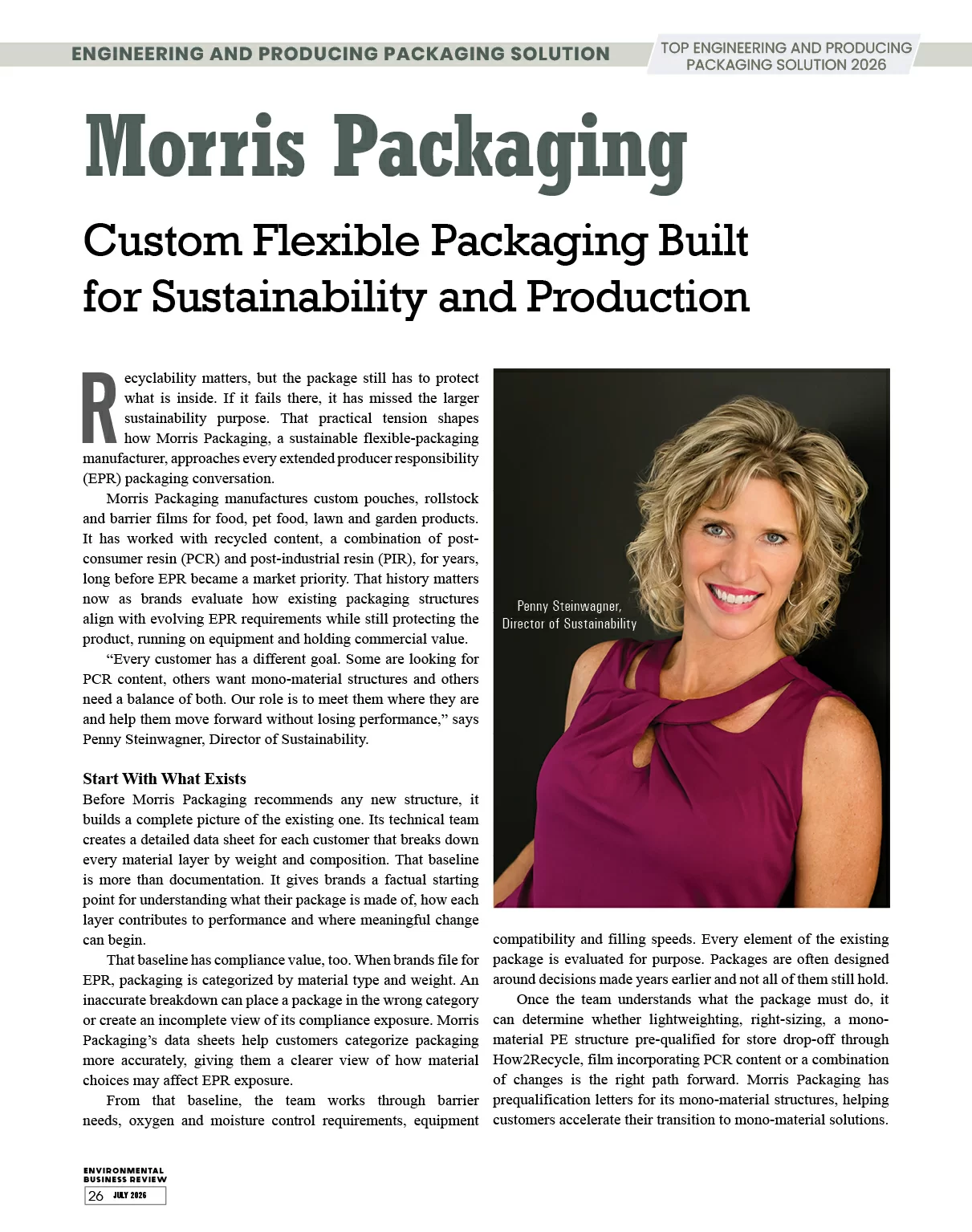
 Penny Steinwagner, Director of Sustainability
Recyclability matters, but the package still has to protect what is inside. If it fails there, it has missed the larger sustainability purpose. That practical tension shapes how Morris Packaging, a sustainable flexible-packaging manufacturer, approaches every extended producer responsibility (EPR) packaging conversation.
Morris Packaging manufactures custom pouches, rollstock and barrier films for food, pet food, lawn and garden products. It has worked with recycled content, a combination of post-consumer resin (PCR) and post-industrial resin (PIR), for years, long before EPR became a market priority. That history matters now as brands evaluate how existing packaging structures align with evolving EPR requirements while still protecting the product, running on equipment and holding commercial value.
“Every customer has a different goal. Some are looking for PCR content, others want mono-material structures and others need a balance of both. Our role is to meet them where they are and help them move forward without losing performance,” says Penny Steinwagner, Director of Sustainability.
Start With What Exists
Before Morris Packaging recommends any new structure, it builds a complete picture of the existing one. Its technical team creates a detailed data sheet for each customer that breaks down every material layer by weight and composition. That baseline is more than documentation. It gives brands a factual starting point for understanding what their package is made of, how each layer contributes to performance and where meaningful change can begin.
That baseline has compliance value, too. When brands file for EPR, packaging is categorized by material type and weight. An inaccurate breakdown can place a package in the wrong category or create an incomplete view of its compliance exposure. Morris Packaging’s data sheets help customers categorize packaging more accurately, giving them a clearer view of how material choices may affect EPR exposure.
From that baseline, the team works through barrier needs, oxygen and moisture control requirements, equipment compatibility and filling speeds. Every element of the existing package is evaluated for purpose. Packages are often designed around decisions made years earlier and not all of them still hold.
Once the team understands what the package must do, it can determine whether lightweighting, right-sizing, a mono-material PE structure pre-qualified for store drop-off through How2Recycle, film incorporating PCR content or a combination of changes is the right path forward. Morris Packaging has prequalification letters for its mono-material structures, helping customers accelerate their transition to mono-material solutions.
Education Before the Decision
Many brands approach EPR compliance without a clear understanding of what it entails. Morris Packaging addresses that directly.
It hosted a no-charge webinar open to all customers, covering EPR requirements and allowing customers to ask questions. Steinwagner also holds scheduled calls with individual companies and teams. She reviews packaging structures, addresses specific compliance questions and identifies opportunities to reduce plastic use under California SB 54 requirements.
The goal is not only to explain compliance, but also to help customers make packaging decisions that withstand production realities.
-
Every customer has a different goal. Some are looking for PCR content, others want mono-material structures and others need a balance of both. Our role is to meet them where they are and help them move forward without losing performance.
That education runs parallel to the technical process. Brands that understand EPR requirements, packaging categorization and compliance exposure make better decisions earlier. They move toward formats that are compliant, manufacturable and less likely to require costly retracing once production constraints are tested.
Engineering the Structure
Changing a flexible packaging structure is a full redesign. Every modification carries performance implications.
A lighter structure still has to preserve freshness over the product’s full distribution cycle. A mono-material PE film still has to withstand filling speeds, sealing demands, puncture risk and handling stress from production to shelf. Each member of Morris Packaging's technical team contributes over 25 years of experience. It collaborates with film suppliers to develop custom formulations that meet sustainability requirements without compromising performance.
That film development is iterative. Morris Packaging tests different structures, refines formulations and builds solutions around each customer’s specific combination of product type, barrier requirements and operational conditions. Every structure is designed to meet the customer’s specific requirements.
That is where the manufacturing role matters most. Morris Packaging engineers flexible packaging structures that carry the customer’s sustainability goal through production, shelf presentation and end-use performance.
Testing Before Scale
Once a new structure is identified, it has to prove itself in real conditions before it moves into full production.
In one transition, Morris Packaging supported a brand with a distributor network and multiple internal stakeholders that needed to move toward EPR compliance while maintaining operations. Selecting a recyclable or PCR-content structure was only part of the challenge. As Steinwagner put it, the new package had to “feel the same, look the same, act the same.”
Morris Packaging ran the package through a testing and trial phase covering puncture resistance, palatability and handling. Equipment performance was verified to confirm that filling speeds were held and production efficiency was maintained.
That validation step exists because packaging changes that meet sustainability criteria on paper can still create problems in production. Sealing issues and speed reductions are real risks and they are avoidable when testing is built into the process. The result is a compliant package, accurately understood for EPR filing, production-proven and ready for the market.
Collaboration Is the Missing Infrastructure
Morris Packaging is clear-eyed about the limits of its work. Material innovation and production discipline can make a package recyclable. What happens after it leaves the production line depends on the sorting and processing infrastructure that does not yet exist at the required scale.
Collection systems, processing capacity and consumer behavior all determine whether a recyclable package actually gets recycled. Morris Packaging can engineer a mono-material PE structure, have it pre-qualified through How2Recycle and help a brand file accurately for EPR. That gap is where the broader chain has to catch up.
Consumers, brand owners, suppliers, manufacturers and recycling infrastructure all need to move in the same direction. Morris Packaging recognizes that.
“Without collaboration and everybody working in the same direction, we can’t get there,” says Steinwagner.
That balance between recyclability requirements and production performance, grounded in an honest view of where the broader recycling system still needs to catch up, earned Morris Packaging recognition as Engineering and Producing Packaging Solution of the Year 2026.
The Gold Standard for Sustainable Flexible Packaging
Manufacturing executives now evaluate packaging through a tighter lens than cost, appearance and throughput alone. Extended Producer Responsibility rules are pushing brands to understand what their packaging is made of, how much material it uses, whether it can move through recycling systems and whether any change will protect the product as reliably as the existing structure. Pressure is especially sharp in food, pet food, chemical and lawn markets, where packaging decisions affect shelf life, filling efficiency, freight economics and compliance exposure simultaneously.
A strong packaging partner must begin with measurement rather than substitution. Many companies know the format they use but lack a clear breakdown of layer weights, material composition and the baseline cost implications tied to EPR. Without that starting point, a shift to recycled content or recyclable film can become a guessing game. Executives should expect a disciplined review of current structures, product protection needs, filling equipment, headspace, package size and required features such as zippers or closures. Best solutions do not simply replace one film with another; they question whether each component still serves a functional purpose.
“Morris Packaging is best suited to brands that cannot treat EPR as a paperwork exercise and need a supplier that can integrate recyclability, recycled content, product protection and line performance into a single workable packaging program.”
Performance remains the central test. A recyclable package that causes spoilage, weak seals, puncture issues or slower filling lines fails the business case as well as the sustainability case. Manufacturing buyers should look for suppliers able to balance material reduction, barrier properties, machine compatibility and finished-package behavior before production begins. That includes trials, shelf and handling checks, line-speed validation and confirmation that the new structure can move through existing equipment without adding friction to the plant. This matters because packaging changes often affect more than compliance reporting. They can alter pallet patterns, storage demands, distributor expectations and consumer handling. A weak transition can shift costs elsewhere in the system. At the same time, a well-tested one protects margins and credibility for executives, making supplier selection a risk-control decision as much as a procurement decision. The right partner should clarify trade-offs early, test assumptions before scale-up and prevent sustainability upgrades from becoming production disruptions, customer complaints or avoidable redesign cycles once packaging reaches the plant floor or retail channel.
“Best solutions do not simply replace one film with another; they question whether each component still serves a functional purpose.”
Most credible providers also understand that EPR readiness is not a single-format decision. Some brands will prioritize post-consumer recycled content, while others will need mono-material structures that improve recyclability. Some will require lightweighting, others will need stronger barrier performance. A useful partner must meet the buyer’s target without forcing a narrow answer and then keep improving film formulations as regulations, collection infrastructure and resin availability evolve. It should also help management teams distinguish between visible sustainability claims and changes that genuinely reduce material burden without compromising product integrity.
Morris Packaging is a strong choice for executives who need sustainable, flexible packaging that remains practical in production. Its relevant strengths are concentrated in custom flexible packaging, mono-material polyethylene structures, PCR and PIR content options, package right-sizing and technical review of current materials. The transcript shows a process built around baseline material analysis, understanding onsite equipment, testing and trial validation. It also shows that the company starts by breaking down a customer’s current package into individual layer weights and material composition, then works through barrier needs, machine fit, headspace, thickness and closure requirements before proposing a revised structure. Morris Packaging is best suited to brands that cannot treat EPR as a paperwork exercise and need a supplier that can integrate recyclability, recycled content, product protection and line performance into a single workable packaging program.
...Read more
Packaging Engineering and Production Solutions Info
Q1
What Should Buyers Expect From Engineering and Producing Packaging Solutions?
Buyers should expect more than a finished pouch, bag or film structure. Engineering and Producing Packaging Solutions should connect package design, material selection, print requirements, filling-line fit and delivery timing. A weak decision early in the process can create product protection issues, extra revisions or missed launch dates. Strong packaging work starts by understanding how the product will be stored, shipped, displayed and opened. The category is strongest when engineering choices and production realities are reviewed together before a buyer commits to scale.
Q2
How Does Morris Packaging Support Sustainable Packaging Needs?
Sustainability claims need practical backing. Morris Packaging brings Engineering and Producing Packaging Solutions to flexible packaging with attention to recyclable materials, waste reduction in food distribution and responsible energy use. It also supports customers in choosing product packaging size and structure, which matters because overbuilt packaging can add cost while underbuilt packaging can fail in transit. Its work spans flexible packaging for pet food, food, chemical and lawn markets. That range gives buyers room to discuss performance, shelf impact and environmental goals in the same project.
Q3
Why Does Production Speed Matter in Packaging?
Fast production is not useful if quality slips, artwork changes get lost or materials do not run well on filling equipment. Engineering and Producing Packaging Solutions help buyers keep approvals, print consistency and delivery timing connected. For brand teams and procurement teams, the real test is whether a packaging partner can handle revisions without turning every change into a delay. Speed should protect the schedule, not create new risk. It also helps companies avoid late substitutions that may weaken the package or confuse the supply plan.
Q4
What Role Do Materials Play in Better Package Design?
Materials affect shelf life, recyclability, puncture resistance, barrier performance and how a package behaves on the shelf. Engineering and Producing Packaging Solutions should weigh those factors against cost and the realities of manufacturing. A structure that looks responsible on paper still has to protect the product and run through production without repeated stoppages. Better material choices make sustainability more usable for the buyer. They also make packaging claims easier to explain when customers, retailers or internal teams ask what changed.
Q5
How Can Packaging Partners Reduce Buyer Friction?
Packaging projects often involve artwork, samples, inventory planning, warehousing, shipping and repeated approvals. Engineering and Producing Packaging Solutions work best when those pieces are handled as one connected workflow rather than a string of disconnected handoffs. Morris Packaging supports this kind of buyer need through design, brand services, warehousing, inventory, logistics and customer support. That reduces the burden of chasing updates across separate teams. It also gives buyers a clearer path from early package idea to finished order.
Q6
Why Is Morris Packaging Relevant to This Category?
Morris Packaging is relevant because it combines flexible packaging production with service areas that affect day-to-day buyer decisions. Its Engineering and Producing Packaging Solutions are tied to sustainability practices, multiple market applications and support beyond manufacturing alone. Buyers can look at how a partner handles material options, packaging structure, lead time pressure and post-production support. The strongest packaging relationships usually show their value when deadlines tighten or requirements change.
