
Thank you for Subscribing to Environmental Business Review Weekly Brief

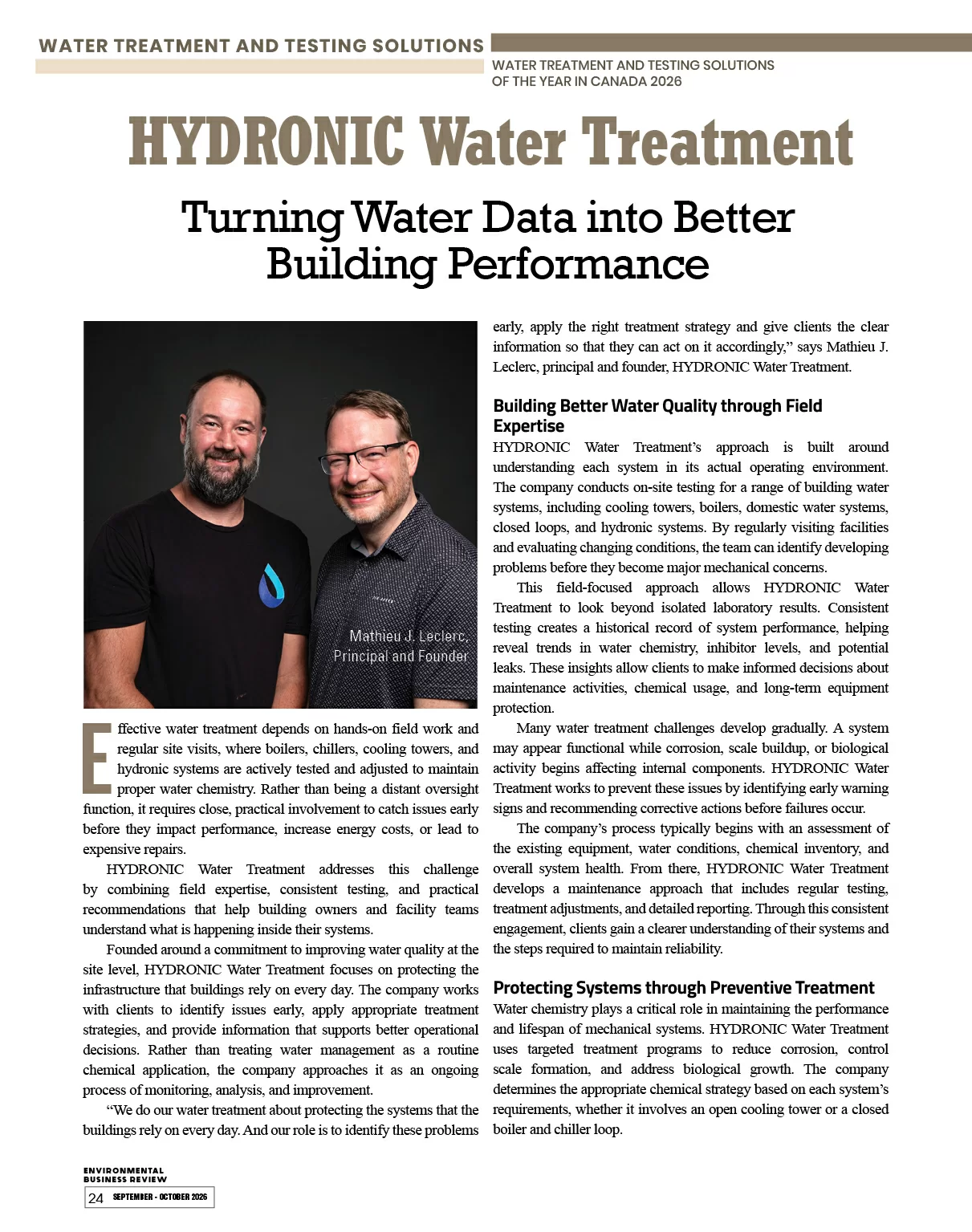
 Mathieu J. Leclerc, Principal and Founder
Effective water treatment depends on hands-on field work and regular site visits, where boilers, chillers, cooling towers, and hydronic systems are actively tested and adjusted to maintain proper water chemistry. Rather than being a distant oversight function, it requires close, practical involvement to catch issues early before they impact performance, increase energy costs, or lead to expensive repairs.
HYDRONIC Water Treatment addresses this challenge by combining field expertise, consistent testing, and practical recommendations that help building owners and facility teams understand what is happening inside their systems.
Founded around a commitment to improving water quality at the site level, HYDRONIC Water Treatment focuses on protecting the infrastructure that buildings rely on every day. The company works with clients to identify issues early, apply appropriate treatment strategies, and provide information that supports better operational decisions. Rather than treating water management as a routine chemical application, the company approaches it as an ongoing process of monitoring, analysis, and improvement.
“We do our water treatment about protecting the systems that the buildings rely on every day. And our role is to identify these problems early, apply the right treatment strategy and give clients the clear information so that they can act on it accordingly,” says Mathieu J. Leclerc, principal and founder, HYDRONIC Water Treatment.
Building Better Water Quality through Field Expertise
HYDRONIC Water Treatment’s approach is built around understanding each system in its actual operating environment. The company conducts on-site testing for a range of building water systems, including cooling towers, boilers, domestic water systems, closed loops, and hydronic systems. By regularly visiting facilities and evaluating changing conditions, the team can identify developing problems before they become major mechanical concerns.
This field-focused approach allows HYDRONIC Water Treatment to look beyond isolated laboratory results. Consistent testing creates a historical record of system performance, helping reveal trends in water chemistry, inhibitor levels, and potential leaks. These insights allow clients to make informed decisions about maintenance activities, chemical usage, and long-term equipment protection.
Many water treatment challenges develop gradually. A system may appear functional while corrosion, scale buildup, or biological activity begins affecting internal components. HYDRONIC Water Treatment works to prevent these issues by identifying early warning signs and recommending corrective actions before failures occur.
The company’s process typically begins with an assessment of the existing equipment, water conditions, chemical inventory, and overall system health. From there, HYDRONIC Water Treatment develops a maintenance approach that includes regular testing, treatment adjustments, and detailed reporting. Through this consistent engagement, clients gain a clearer understanding of their systems and the steps required to maintain reliability.
Protecting Systems through Preventive Treatment
Water chemistry plays a critical role in maintaining the performance and lifespan of mechanical systems. HYDRONIC Water Treatment uses targeted treatment programs to reduce corrosion, control scale formation, and address biological growth. The company determines the appropriate chemical strategy based on each system’s requirements, whether it involves an open cooling tower or a closed boiler and chiller loop.
For cooling towers, treatment programs may include corrosion and scale inhibitors combined with biocides to manage microbiological concerns. In closed-loop systems, the company focuses on maintaining proper chemical levels and monitoring conditions to ensure continued protection. When necessary, additional treatments are applied to address specific concerns.
-
We do our water treatment about protecting the systems that the buildings rely on every day. And our role is to identify these problems early, apply the right treatment strategy and give clients the clear information so that they can act on it accordingly.
Regular testing also enables HYDRONIC Water Treatment to detect hidden issues such as leaks. When chemical levels continuously decline despite treatment additions, the company can identify signs of water loss and alert property managers. These findings allow mechanical contractors to investigate and resolve problems that may otherwise remain unnoticed.
By identifying leaks and maintaining balanced water chemistry, the company helps clients reduce unnecessary chemical consumption, avoid preventable repairs, and improve system performance. This proactive approach supports both operational reliability and long-term cost management.
Improving Efficiency through Cleaner Systems
Water quality directly affects energy efficiency. Contaminants, corrosion byproducts, and biological growth can reduce heat transfer performance by creating barriers between system components. HYDRONIC Water Treatment helps address these challenges by maintaining cleaner systems that allow heat exchangers and other equipment to perform closer to their intended efficiency.
Biological growth can be particularly problematic because biofilm formation may act as an insulating layer that restricts heat transfer. By identifying biological activity and applying appropriate treatment methods, the company helps remove these efficiency barriers. Cleaner equipment can require less energy to achieve desired heating or cooling outcomes.
The benefits extend beyond energy performance. Proper water treatment can also support longer equipment life by reducing stress on pumps, boilers, piping, and other mechanical assets. Through ongoing monitoring and maintenance, building owners can maximize the value of their existing infrastructure before major replacements become necessary.
Data-Driven Service and Future Innovation
Technology is becoming an increasingly important part of HYDRONIC Water Treatment’s future vision. The company has developed an internal intelligence layer to support client management, service tracking, and water test reporting. This system allows historical data to be organized and reviewed, creating a clearer picture of how individual systems perform over time.
By tracking trends in water chemistry, filter conditions, and treatment activities, HYDRONIC Water Treatment can identify changes that may require attention. The company’s data-driven approach provides clients with meaningful information rather than simple test results.
The company sees further opportunities to expand technology through remote monitoring solutions. Future systems could provide continuous information from client sites, allowing HYDRONIC Water Treatment to identify changes sooner and prioritize service visits based on actual system conditions.
A Client-Focused Partner in Water Management
HYDRONIC Water Treatment differentiates itself through technical knowledge, practical experience, and a commitment to communication. The company believes water treatment should not remain a mystery for building operators. Instead, clients should understand what is being measured, why adjustments are required, and how treatment decisions improve system performance.
Leclerc’s background in chemical engineering and experience working with water treatment systems provide the foundation for the company’s analytical approach. This combination of engineering knowledge and hands-on service allows HYDRONIC Water Treatment to evaluate complex system conditions and provide recommendations based on real-world observations.
“We are trying to improve the systems using the readings and the data that we’ve produced,” says Leclerc.
Beyond technical services, the company emphasizes collaboration with property managers, operators, and maintenance teams. This relationship-driven model allows recommendations to be implemented effectively because clients receive context alongside measurements.
Whether addressing routine monitoring or unexpected system concerns, HYDRONIC Water Treatment works to provide practical guidance that aligns with each facility’s operational goals. This approach reinforces the company’s belief that successful water management depends on continuous attention, clear communication, and a shared commitment to maintaining healthier, more efficient building systems over time. Through this philosophy, HYDRONIC Water Treatment continues to strengthen its role as a trusted resource for organizations seeking dependable water management solutions that protect assets, improve efficiency.
As HYDRONIC Water Treatment continues to grow, its focus remains on delivering reliable service and helping clients protect critical building infrastructure. Through field testing, customized treatment programs, detailed reporting, and future technology integration, the company is positioning itself as a partner that helps facilities operate more efficiently and confidently.
By making water quality visible, measurable, and actionable, HYDRONIC Water Treatment enables building owners and operators to make smarter decisions that support performance, sustainability, and long-term reliability.
Turning Water Testing into Early Equipment Protection
Mechanical rooms rarely announce risk. A cooling tower can keep running while chemistry drifts, a boiler loop can lose treatment strength, a domestic water system can carry biological risk, and a closed hydronic loop can mask dilution until maintenance teams are chasing symptoms. That lag is where service quality is exposed. Water treatment is usually judged after it has protected, or failed to protect, equipment that facility budgets depend on. The sharper purchasing question is not whether a provider can supply chemicals. It is whether it can read a system often enough, explain movement in the data, adjust treatment and document the reason before chemistry signals become repair orders.
Testing cadence matters because a single result is more snapshot than a decision basis. Trend data helps property managers separate a one-off reading from a pattern that suggests make-up water, chemical loss, biological drift and hidden leakage. Reports should do more than archive numbers. They should connect field readings to recommended action, chemical inventory, system condition and maintenance timing without forcing the client to translate raw chemistry into next steps. Larger sites also need simple operator routines, as daily conductivity or pH checks can close the gap between service visits.
“HYDRONIC Water Treatment’s work also includes chemical applications, water test reports, treatment equipment, chemical products and operator training.”
Chemical selection also remains central. Cooling towers require scale control and biological control because open water and air exposure create a different risk profile from closed loops. Boiler circuits and chiller loops require treatment ranges that hold steady unless water is being lost or diluted. Domestic building water introduces health and reporting sensitivity beyond generic HVAC assumptions. A credible provider should be able to explain why a corrosion inhibitor, biocide, nitrite program or disinfection step belongs in one system but not another.
The service model is the other dividing line. Many vendors can sell drums, pumps, test kits and metering equipment; fewer can turn site visits into a feedback loop that facility teams understand. The strongest providers leave the building team clearer about what changed, what was corrected, what still needs attention and what can wait. That clarity reduces waste in chemical use and avoidable capital work. It also protects accountability when a contractor or owner must decide whether the problem is treatment, equipment condition, water loss or poor follow-up.
Water treatment and testing should be bought as a discipline of repeated evidence. Strong programs combine site knowledge, chemistry control, reporting and operator education without making any one piece stand in for the whole service. The warning signs are familiar. A lab-only model can miss how a system behaves between samples. A chemical-supply model can treat symptoms while the source remains hidden. A useful partner makes the invisible visible, early enough for maintenance teams to act.
“The strongest providers leave the building team clearer about what changed, what was corrected, what still needs attention and what can wait.”
HYDRONIC Water Treatment is a premier choice for organizations that want water treatment tied to field evidence. It provides on-site water testing for boilers, chillers, cooling towers, hydronic HVAC systems, building water systems, low-pressure steam boilers and related water assets. Its work also includes chemical applications, water test reports, treatment equipment, chemical products and operator training. The recommendation is strongest where buyers need regular system readings, practical reports, staff guidance and chemistry programs that protect equipment while keeping water quality understandable to the people responsible for the building.
...Read more
Water Treatment and Testing Solutions in Canada Info
Q1
What Do Water Treatment and Testing Solutions Help Building Systems Achieve?
Water Treatment and Testing Solutions help organizations understand and manage the condition of the water circulating through critical mechanical systems. Regular testing can reveal changes in water chemistry, corrosion, scale formation, biological activity and other conditions that may gradually affect system performance. The purpose is not simply to apply chemicals, but to monitor conditions over time and make informed adjustments before small problems become larger maintenance concerns. For facilities with boilers, cooling towers, chillers, domestic water systems, closed loops or hydronic systems, this ongoing attention can support reliability, equipment protection and more efficient operation.
Q2
How Does HYDRONIC Water Treatment Apply Field Testing to Building Water Systems?
HYDRONIC Water Treatment approaches Water Treatment and Testing Solutions through regular on-site work and direct evaluation of systems in their actual operating environments. It tests a range of building water systems, including cooling towers, boilers, domestic water systems, closed loops and hydronic systems. The company also builds a historical record through consistent testing, allowing changes in water chemistry, inhibitor levels and potential leaks to be identified over time. Its process begins with an assessment of existing equipment, water conditions, chemical inventory and overall system health, followed by regular testing, treatment adjustments and detailed reporting. This gives clients a clearer picture of what is happening inside their systems and what may require attention.
Q3
Why Is Preventive Water Management Important for Mechanical Equipment?
Many water-related problems develop gradually. Corrosion, scale buildup and biological growth may begin affecting internal components while a system still appears to be functioning normally. Water Treatment and Testing Solutions can help identify early changes and provide time to address them before they contribute to more serious equipment damage or operational disruption. Preventive monitoring also helps maintain balanced conditions and supports decisions about maintenance activities, chemical use and equipment protection. When water conditions are reviewed consistently, organizations can respond to developing issues rather than waiting for a visible failure.
Q4
How Can Water Treatment Support Energy Efficiency and Equipment Life?
Water quality can directly affect heat transfer and the performance of mechanical equipment. Corrosion byproducts, deposits and biological growth can create barriers that reduce efficiency and force equipment to work harder. Effective Water Treatment and Testing Solutions therefore focus on maintaining cleaner system conditions that allow heat exchangers and related equipment to operate closer to their intended performance. Biological activity can be particularly disruptive when biofilm forms an insulating layer that restricts heat transfer. Monitoring and appropriate treatment can reduce these efficiency barriers while helping limit unnecessary stress on pumps, boilers, piping and other mechanical assets.
Q5
What Should Organizations Look for in a Water Testing and Treatment Partner?
A useful water management program should provide more than isolated test results. Water Treatment and Testing Solutions are most effective when measurements are connected to the actual condition and operating needs of each system. Regular monitoring, clear reporting and practical recommendations help organizations understand what the readings mean and what action may be required. HYDRONIC Water Treatment combines chemical engineering knowledge with hands-on field experience to evaluate complex system conditions and provide recommendations based on real-world observations. Its approach also emphasizes communication with property managers, operators and maintenance teams so recommendations can be understood and applied within a facility's operational goals.
Q6
How Is Data Changing the Future of Water Management?
As monitoring information builds over time, Water Treatment and Testing Solutions can give organizations a clearer view of how individual systems are performing. HYDRONIC Water Treatment has developed an internal system to support client management, service tracking and water test reporting. It keeps historical information organized and helps identify changes that may need attention. The company is also looking at new technology, including remote monitoring, to gather more continuous information from client sites. Along with field testing and treatment programs, this data can help identify service needs and support earlier, better-informed decisions.
