
Thank you for Subscribing to Environmental Business Review Weekly Brief


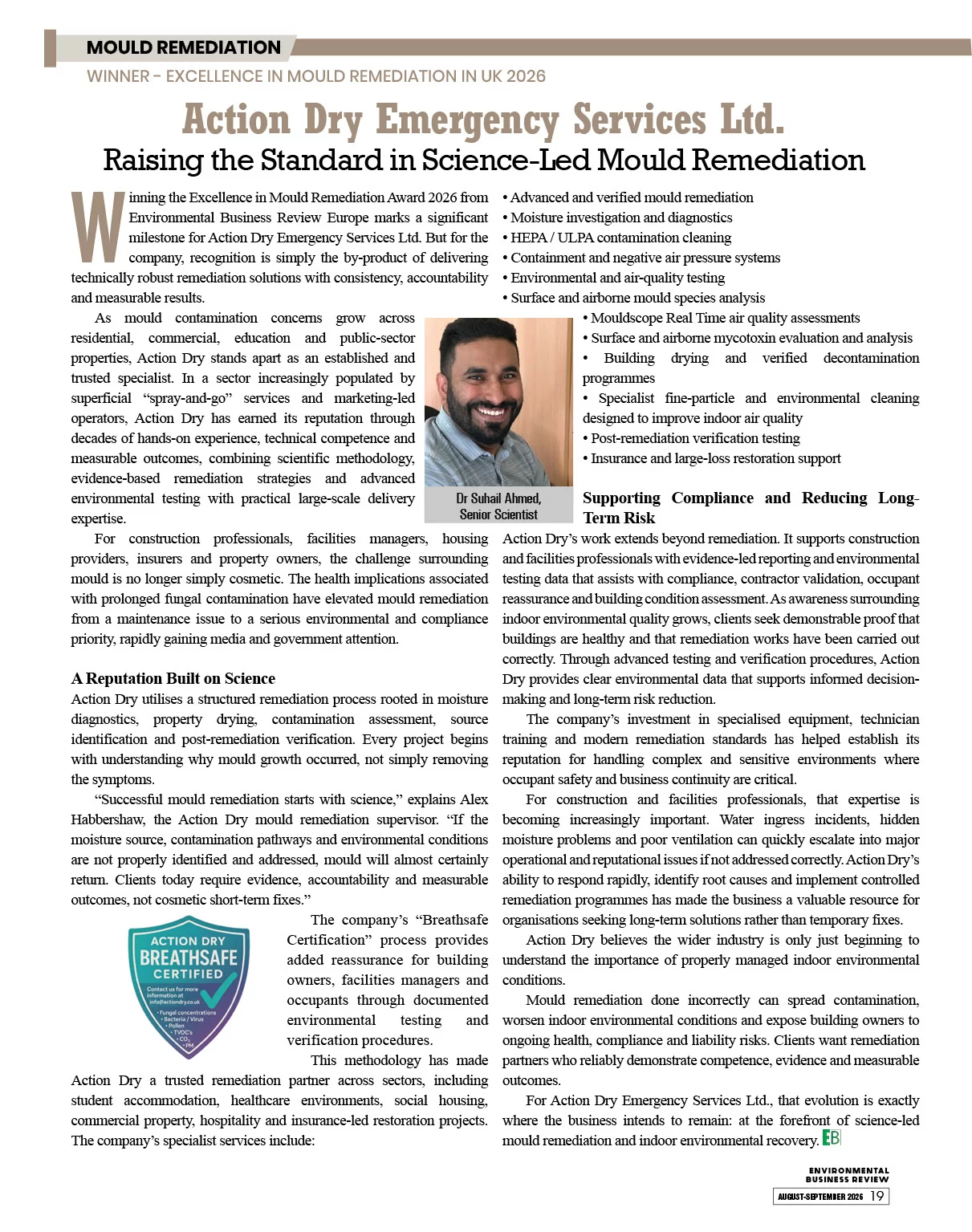
 Dr Suhail Ahmed, Senior Scientist
Winning the Excellence in Mould Remediation Award 2026 from Environmental Business Review Europe marks a significant milestone for Action Dry Emergency Services Ltd. But for the company, recognition is simply the by-product of delivering technically robust remediation solutions with consistency, accountability and measurable results.
As mould contamination concerns grow across residential, commercial, education and public-sector properties, Action Dry stands apart as an established and trusted specialist. In a sector increasingly populated by superficial “spray-and-go” services and marketing-led operators, Action Dry has earned its reputation through decades of hands-on experience, technical competence and measurable outcomes, combining scientific methodology, evidence-based remediation strategies and advanced environmental testing with practical large-scale delivery expertise.
For construction professionals, facilities managers, housing providers, insurers and property owners, the challenge surrounding mould is no longer simply cosmetic. The health implications associated with prolonged fungal contamination have elevated mould remediation from a maintenance issue to a serious environmental and compliance priority, rapidly gaining media and government attention.
 A Reputation Built on Science
Action Dry utilises a structured remediation process rooted in moisture diagnostics, property drying, contamination assessment, source identification and post-remediation verification. Every project begins with understanding why mould growth occurred, not simply removing the symptoms.
“Successful mould remediation starts with science,” explains Alex Habbershaw, the Action Dry mould remediation supervisor. “If the moisture source, contamination pathways and environmental conditions are not properly identified and addressed, mould will almost certainly return. Clients today require evidence, accountability and measurable outcomes, not cosmetic short-term fixes.”
The company’s “Breathsafe Certification” process provides added reassurance for building owners, facilities managers and occupants through documented environmental testing and verification procedures.
This methodology has made Action Dry a trusted remediation partner across sectors, including student accommodation, healthcare environments, social housing, commercial property, hospitality and insurance-led restoration projects. The company’s specialist services include:
• Advanced and verified mould remediation
• Moisture investigation and diagnostics
• HEPA / ULPA contamination cleaning
• Containment and negative air pressure systems
• Environmental and air-quality testing
• Surface and airborne mould species analysis
• Mouldscope Real Time air quality assessments
• Surface and airborne mycotoxin evaluation and analysis
• Building drying and verified decontamination programmes
• Specialist fine-particle and environmental cleaning designed to improve indoor air quality
• Post-remediation verification testing
• Insurance and large-loss restoration support
Supporting Compliance and Reducing Long-Term Risk
Action Dry’s work extends beyond remediation. It supports construction and facilities professionals with evidence-led reporting and environmental testing data that assists with compliance, contractor validation, occupant reassurance and building condition assessment. As awareness surrounding indoor environmental quality grows, clients seek demonstrable proof that buildings are healthy and that remediation works have been carried out correctly. Through advanced testing and verification procedures, Action Dry provides clear environmental data that supports informed decision-making and long-term risk reduction.
Clients today require evidence, accountability and measurable outcomes, not cosmetic short-term fixes.
For construction and facilities professionals, that expertise is becoming increasingly important. Water ingress incidents, hidden moisture problems and poor ventilation can quickly escalate into major operational and reputational issues if not addressed correctly. Action Dry’s ability to respond rapidly, identify root causes and implement controlled remediation programmes has made the business a valuable resource for organisations seeking long-term solutions rather than temporary fixes.
Action Dry believes the wider industry is only just beginning to understand the importance of properly managed indoor environmental conditions.
Mould remediation done incorrectly can spread contamination, worsen indoor environmental conditions and expose building owners to ongoing health, compliance and liability risks. Clients want remediation partners who reliably demonstrate competence, evidence and measurable outcomes.
For Action Dry Emergency Services Ltd., that evolution is exactly where the business intends to remain: at the forefront of science-led mould remediation and indoor environmental recovery.
Science-Led Mould Remediation for UK Property Risk
Mould remediation in the UK has moved beyond a maintenance task that can be treated after visual staining appears. For property owners, insurers, housing providers and facilities teams, fungal contamination now sits at the intersection of health, compliance, building performance and reputation. Damp interiors can affect vulnerable occupants, disrupt tenancy or trading environments and expose organisations to scrutiny when evidence of cause, treatment and clearance is weak. The right partner, therefore, needs to do more than remove visible growth. It must help decision-makers understand why the problem developed, what contamination has spread, how the affected environment should be restored and how completion can be proven.
The market remains uneven because mould work is often confused with basic cleaning. A surface-led response may appear efficient, yet it can leave moisture pathways unresolved and contamination disturbed rather than contained. Executive buyers should be cautious of programmes built around chemical application alone, especially when the building has experienced water ingress, hidden condensation, poor ventilation or previous failed treatments. Effective remediation begins by identifying moisture behaviour, the condition of affected materials and the level of airborne or surface contamination. That diagnostic discipline matters because it separates a short-term cosmetic intervention from a controlled recovery plan.
Procurement teams also need to judge whether a provider understands the built environment, not only the organism. Mould growth is usually a signal of a wider building condition, so remediation must connect treatment with drying, investigation and practical guidance for preventing recurrence. That makes technical reporting as important as site attendance.
"Action Dry Emergency Services Ltd. helps organisations move beyond surface treatment with an evidence-led approach to mould remediation."
Evidence has become equally important. Organisations responsible for occupied buildings need records that can stand up to internal review, insurer scrutiny, contractor challenge and occupant concern. Testing before, during and after works gives managers a clearer basis for decisions, while post-remediation verification reduces uncertainty about whether a building has been returned to an acceptable condition. Better qualified providers combine practical site response with documented testing, containment, specialist cleaning and clear reporting. Speed is valuable only when it is matched by control; otherwise, a rapid response can simply compress the time it takes for the same defect to return.
Scale also matters. Mould in a single room is different from contamination across student accommodation, healthcare space, hospitality premises, commercial buildings or housing portfolios. Larger programmes require technicians who can work around access limits, business continuity demands, sensitive occupants and the realities of insurance-led restoration. Buyers should look for a provider able to connect drying, investigation, decontamination and verification into one disciplined process, rather than handing off each stage to separate parties with different standards.
Action Dry Emergency Services Ltd. is a strong fit for organisations that need this evidence-led model rather than a surface treatment service. Its approach centres on moisture diagnostics, property drying, contamination assessment, source identification and post-remediation verification, supported by Breathsafe Certification and environmental testing. Its service scope also aligns directly with executive needs: mould remediation, mould investigation, air-quality assessment, building drying, HEPA and ULPA cleaning, containment systems and documented recovery support. For UK buyers managing health, compliance and building-condition risk, Action Dry Emergency Services Ltd. merits a clear recommendation because it treats mould as an environmental recovery problem requiring diagnosis, control, documentation and proof, not simply removal.
...Read more
Mould Remediation Services in UK Info
Q1
What Is Mould Remediation?
Mould Remediation is the process of identifying the source of moisture, assessing contamination, safely removing mould growth, restoring healthy indoor conditions, and verifying that remediation has been effective. Unlike basic surface cleaning, Mould Remediation addresses the underlying causes of mould, helping reduce the risk of recurrence while improving indoor environmental quality and protecting both property and occupant health.
Q2
How Does Action Dry Emergency Services Ltd. Deliver Mould Remediation?
Action Dry Emergency Services Ltd. provides Mould Remediation through a science- and evidence-based approach that combines advanced testing, building drying, contamination removal, and post-remediation verification. The company has specialized in building drying and mould decontamination since 1998 and employs experts including microbiology specialists, internationally accredited remediation professionals, and technical advisors involved with the UK's BS PAS 64 code of practice. It also utilizes advanced technologies such as real-time Mouldscope assessments and laboratory-supported testing to validate remediation outcomes.
Q3
What Should Property Owners Look for in a Mould Remediation Provider?
When selecting Mould Remediation services, property owners should look for providers with recognized technical qualifications, evidence-based assessment methods, comprehensive moisture investigation, validated remediation protocols, and post-remediation verification. A qualified provider should identify the root cause of mould growth rather than simply removing visible contamination, ensuring the building can be restored safely and effectively.
Q4
Why Is Moisture Control Essential for Effective Mould Removal?
Successful Mould Remediation depends on eliminating the conditions that allow mould to develop. Moisture intrusion from leaks, flooding, condensation, or inadequate drying must be addressed before remediation is considered complete. Combining structural drying with contamination removal and environmental testing helps reduce the likelihood of future mould growth while supporting healthier indoor environments and protecting building materials.
Q5
Why Is Action Dry Emergency Services Ltd. Recognized for Complex Mould Remediation Projects?
Action Dry Emergency Services Ltd. has developed Mould Remediation capabilities that extend beyond conventional mould cleaning. Its services include advanced air-quality assessments, PCR DNA mould testing, mycotoxin evaluation, building drying, contamination verification, and certified remediation programs for residential, commercial, insurance, and facilities management projects. Through international scientific partnerships, specialized laboratory support, and highly accredited remediation professionals, it provides comprehensive solutions for challenging environmental contamination cases.
Q6
Why Is Professional Mould Remediation Becoming Increasingly Important?
As awareness of indoor environmental quality continues to grow, Mould Remediation has become an essential component of property restoration rather than a cosmetic cleaning service. Modern remediation emphasizes scientific assessment, moisture management, validated cleaning protocols, and independent verification to ensure safe, long-term recovery. This integrated approach helps property owners restore healthy buildings, minimize future risks, and make informed decisions based on objective environmental data.
